

Sieving Dirt
Notes from the Front Line of a Clay Plaster Workshop

The weather had undergone an entire personality change by the time the clay plaster workshop began. The dark rain clouds that had hung over us so obstinately the previous week had been replaced by thick white clots of cumulus. Now that the sun had a horse in the game, it was suddenly rather hot.
I had six willing victims for clay plastering, and we had plenty to render. But there was one recurring issue that persistently slowed us down. The sieve.
“You know Atulya, this mesh isn’t holding up. Maybe we can make another dirt sieve.” Alex was sitting on a bucket pushing soil around our freshly made dirt screen. Instead of a raincoat, he now donned a baseball cap pulled over his black hair to give him some shade. I took a closer look at the sieve. Already there was a hole in it.
“Agh, so annoying. Plastic mesh isn’t the right material. But hey, it’s what we’ve got, so I had to use it.”
I remembered making the offending sieve with a RisingSoul volunteer ten days prior. The volunteer had lovingly stapled all the edges flat and made the thing look beautiful. Sadly, neatness was of little use when it came to sieving dirt.
Nearby, a tarp was stretched out on the flagstones, and the indefatigable Sage stood barefoot in the middle of it, ankle-deep in muddy stodge. Gone was the yellow beanie. Out of her otherwise shaven head sprouted two small pink bunches of hair. She was joined in the mud pit by Jen, a travel writer from Greece more used to hiking the backwoods of the Dodecanese than negotiating mud pits.
“It’s like squeezing grapes,” said Jen. Her silver-blonde hair was tied back, and as she stamped through the mixture, I noted that her calf muscles looked useful.
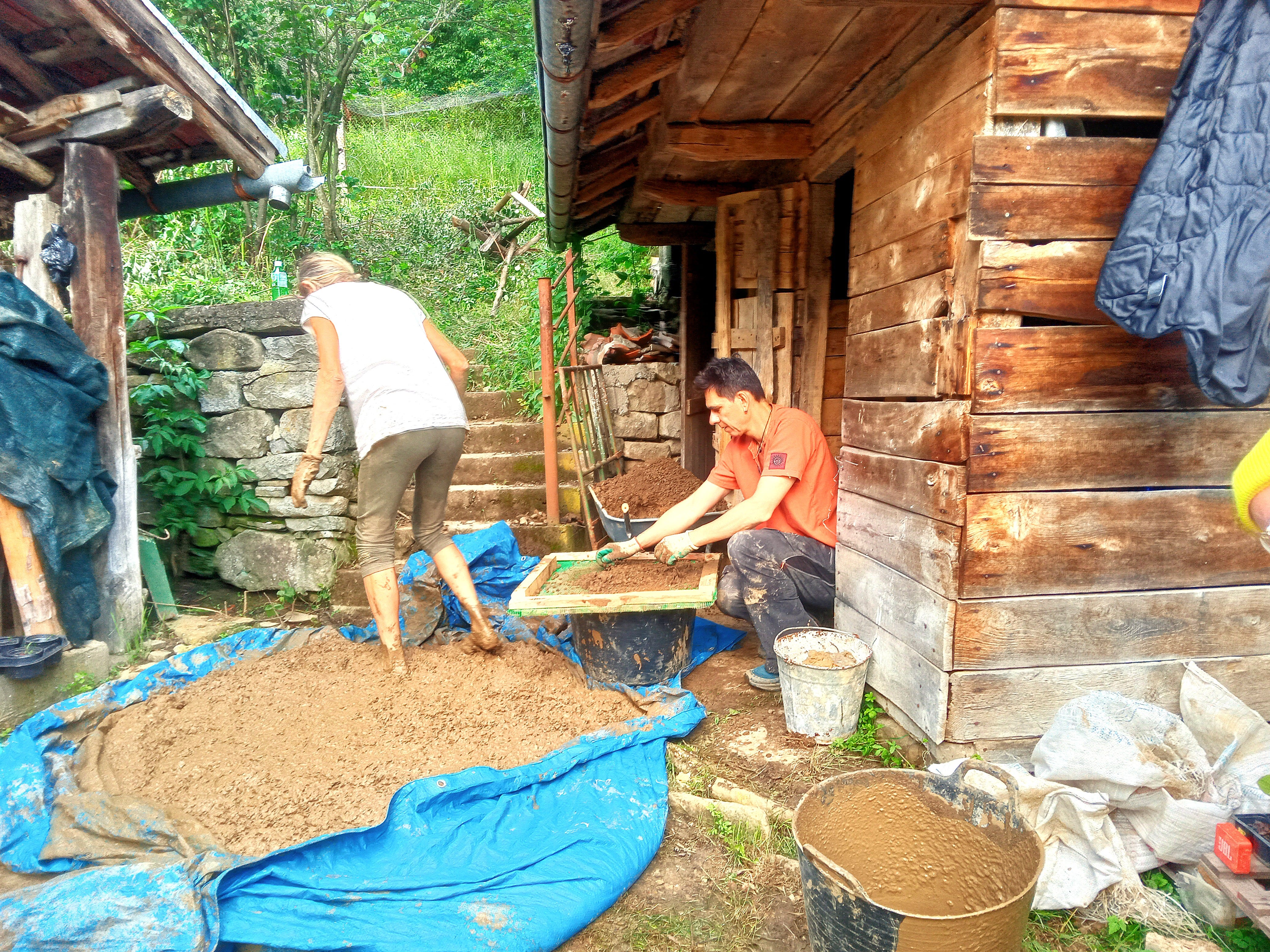
Both Sage and Alex, alumni from the cob course, had remained for the plastering. In addition to film making, Alex was a bamboo expert and keen to build a bamboo-mud hybrid structure on a plot of land he’d bought in Portugal. Sage, as far as I could tell, was here for the ride. But here’s the thing: It’s the ride, not the map, that actually gets you to the destination, isn’t it?
“I should be taking some photos of my feet. A lot of people have feet fetishes, you know,” she said, and her grin reached from ear to ear, lighting up the mud pit as she squished the fresh plaster mix through her toes.
The sun beat down. Beads of perspiration appeared on Alex’s brow. The hole in the dirt screen was growing faster than the weeds after the last rain, but the man at the mesh kept at it.
At this juncture, Irina, a Bulgarian woman of my own age with a large rural project in the north of the country, walked over. She was a practical woman, well used to the reality of construction and getting things done. The type of person I give a little sigh of relief at when they arrive. She took one look at the sieve.
“Where’s the drill?” she growled. “Let’s sort that thing out and make it work.” And off she strode to the tool shed with intent.
Sieving dirt is a great metaphor for what happens with any kind of creation. You’re refining, keeping what works and throwing away what doesn’t. This is how anything, from houses to lightbulbs, turns from an idea into a reality. There is a peculiar fantasy floating about in the minds of many people that things arrive in the world perfect first time. They never do.
So it was that Alex and Irina joined forces to sort the damn sieve out. It was a dream team really, as both were self-starters and, dare I say it, veering on the more perfectionist edge of the quality control scale. I saw Irina ripping the plastic mesh off the wooden frame with gusto, while Alex measured a fresh piece of mesh. Chicken wire appeared, along with screws and other tools. I salivated at the idea of a decent screen.
While Alex and Irina embroiled themselves in Operation Dirt Screen, the rest of the team set about creating a fine finishing plaster. Some were softening the remaining clay. To do this, they waded into a bucket full of clay and water, usually getting rather stuck in the process and staggering about like mud zombies. Jen was particularly efficient at this job, but then she had those hiker’s calves.
“I mean it’s fun, isn’t it?” she giggled.
Some folk, however, were less keen on getting dirty. Latcho, a neat and tidy young coder from Sofia, peered at the clay slop dubiously and did his utmost to avoid the brown scourge. I was almost certain he’d been dragged along by his girlfriend Nona, an architect who was deeply fascinated by natural building. But you never know with mud who will come out with what. No one who enters it emerges quite the same.
Nona dipped her hands in one of the buckets of clay and began kneading it. She was a petite young woman in a little cloth dress who looked in danger of being swallowed up by her wellington boots. But what she lacked in size, she made up for in questions.
“So how would you normally make a sieve, because this one is no good? What size would you make it?” She tried to keep her long hair out of the mud as she wrestled the clay into liquid form.
“Normally I’d get a bit of 4mm weldmesh and screw it onto a wooden frame that fits nicely over a wheelbarrow,” I said. “But there’s no weldmesh.”
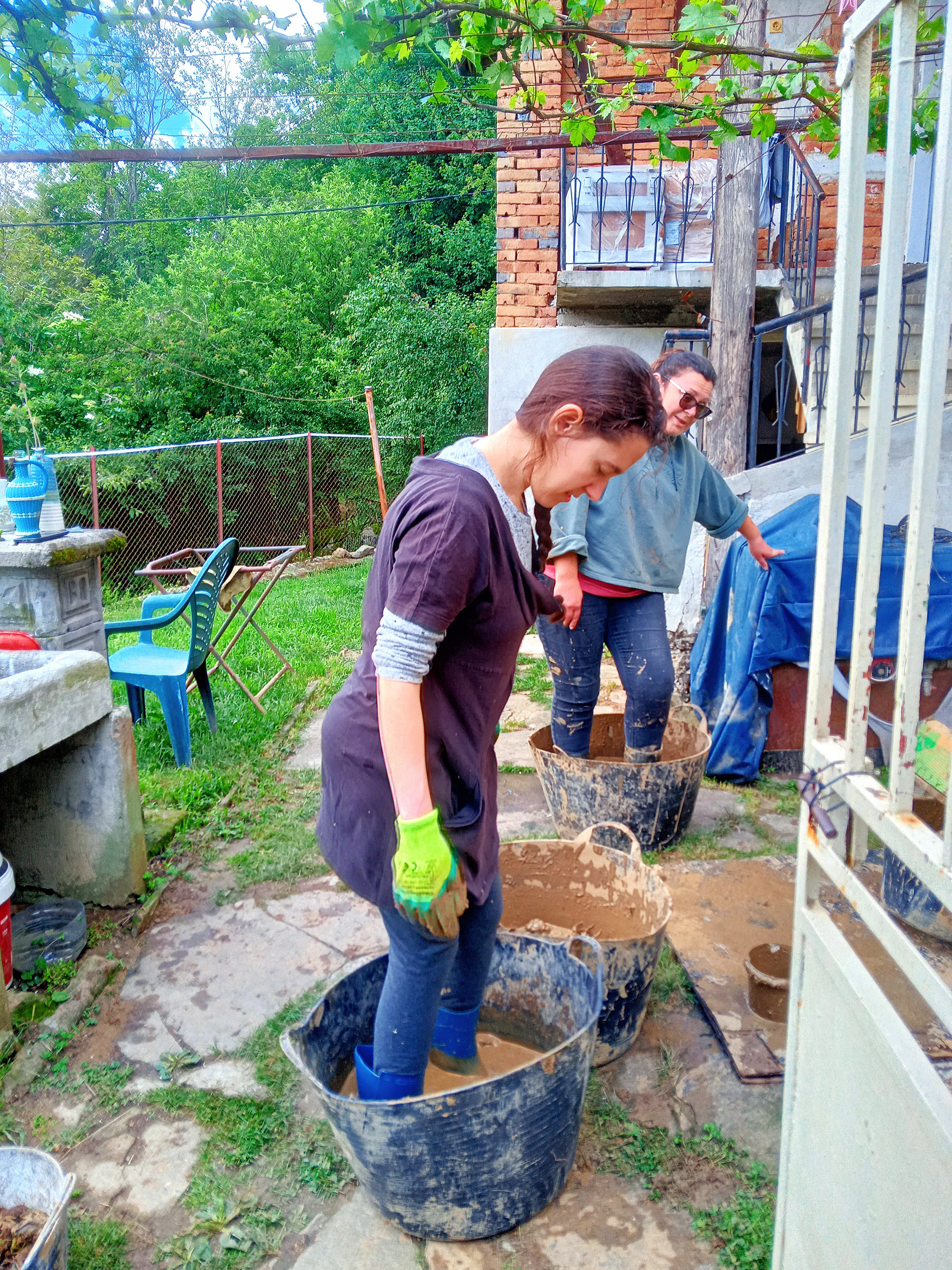
Alex and Irina worked hard. Mesh was cut. Chicken wire was laid above the mesh to protect it, and the sieve was screwed together in the most professional fashion. Soon Alex brandished the creation proudly. It looked amazing, and the clay softeners grabbed it hungrily, ready to sieve the clay.
Jen and Nona, who were both by now looking decidedly muddified, held the new screen over a bucket. Jen poured the clay through the mesh, and Nona began trying to press through a few stodgy clay lumps.
“It’s not working,” she said, her long hair now dotted with mud lumps.
I peered over. The problem was immediately obvious. The chicken wire, which had been laid over the top to protect the mesh, was tight, but the mesh slackened beneath. This meant the clay became trapped between the two layers. Alex and Irina ran over, shoulders sinking, clearly disappointed.
“We thought that would stop the mesh breaking,” said Alex.
“It seemed like a good idea,” said Irina.
“Doesn’t it always?” I chuckled. So it goes with construction. One of the most fundamental lessons of creation was quietly writing itself: nobody nails it on the first attempt. As I’m oft wont to say. If you haven’t made a mistake, it’s because you haven’t built anything.
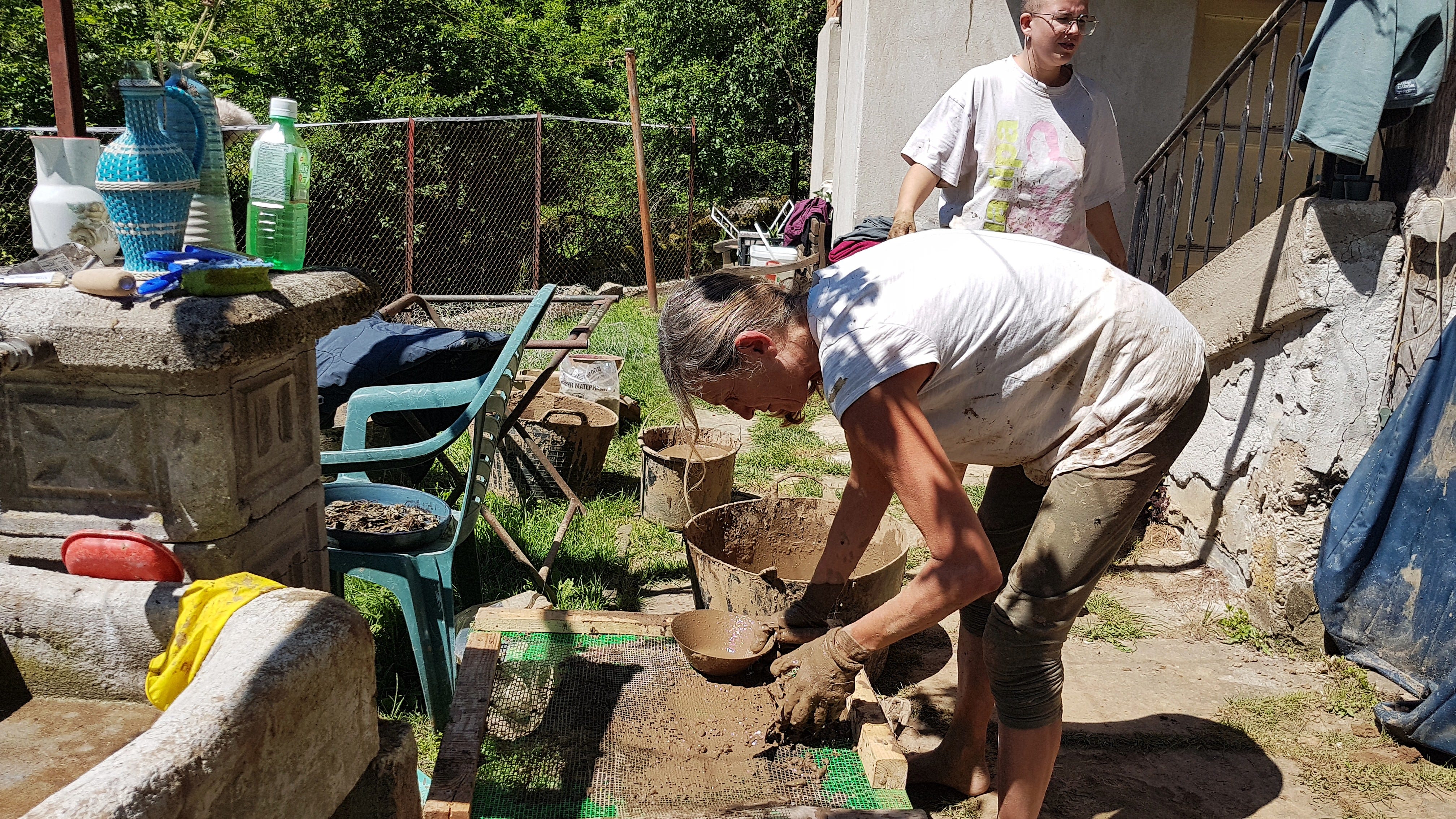
“The bottom line is we needed a metal mesh, and we didn’t have one,” I said. Then I shrugged. “Ah, just turn the thing upside down and try and sieve a bit gently. We’ll have to fudge along with it until we’re done.”
The classic strategy when all else fails. Fudge along we did. It was tedious. It was cumbersome. And the team had to keep holding different parts of the screen over the bucket. But sometimes, to get the job done, you just have to make the best of what you’ve got. Nevertheless, Irina sighed long and hard. She looked exasperated. If I could have read her mind, it might well have said something along the lines of, “Why don’t things just work?”
Alex might have done the same the previous week, but he was a cob course ahead, and getting used to the way of it. Thus he adopted a facial expression that loitered somewhere between Zeno of Citium and Yoda.
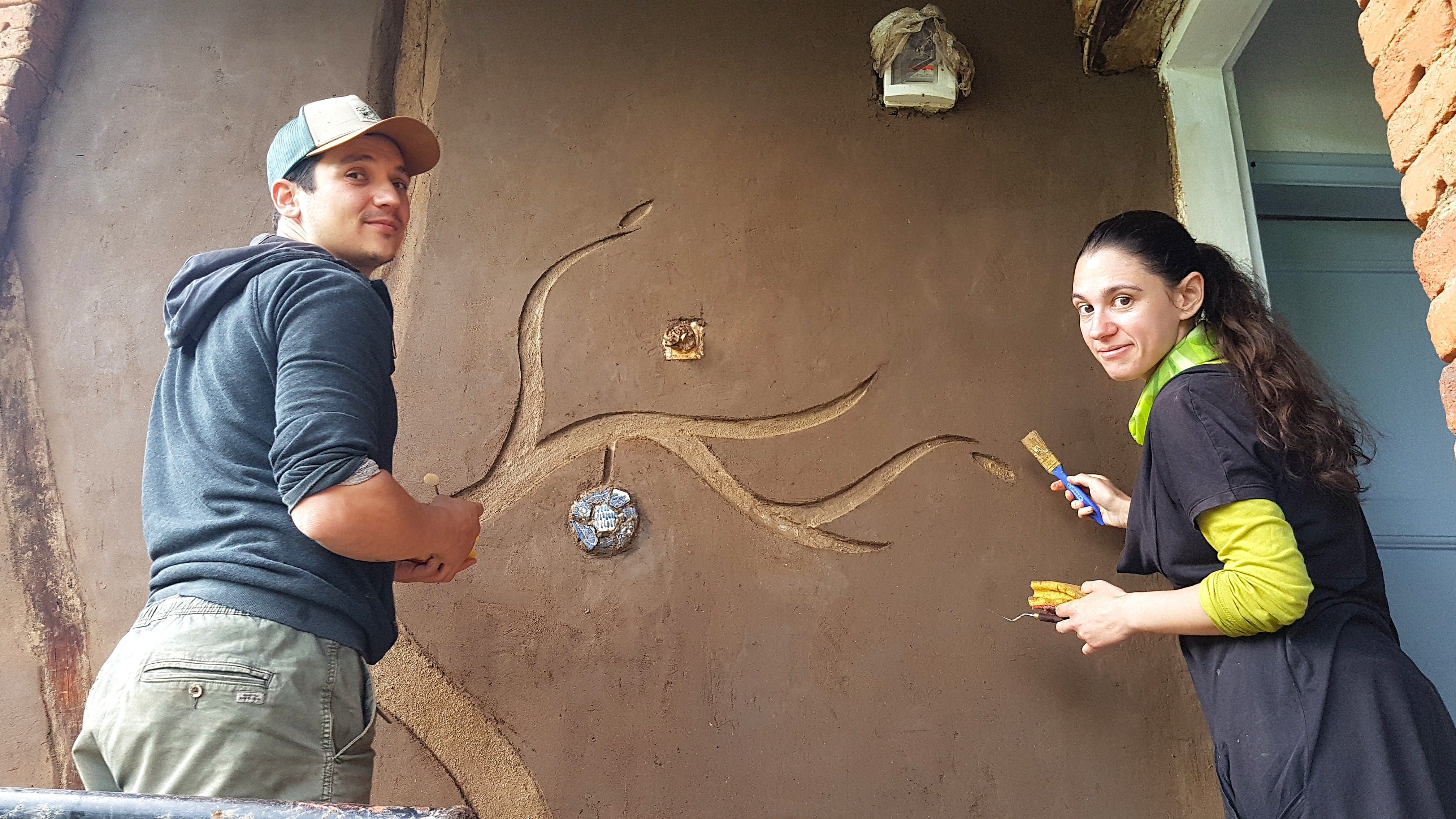
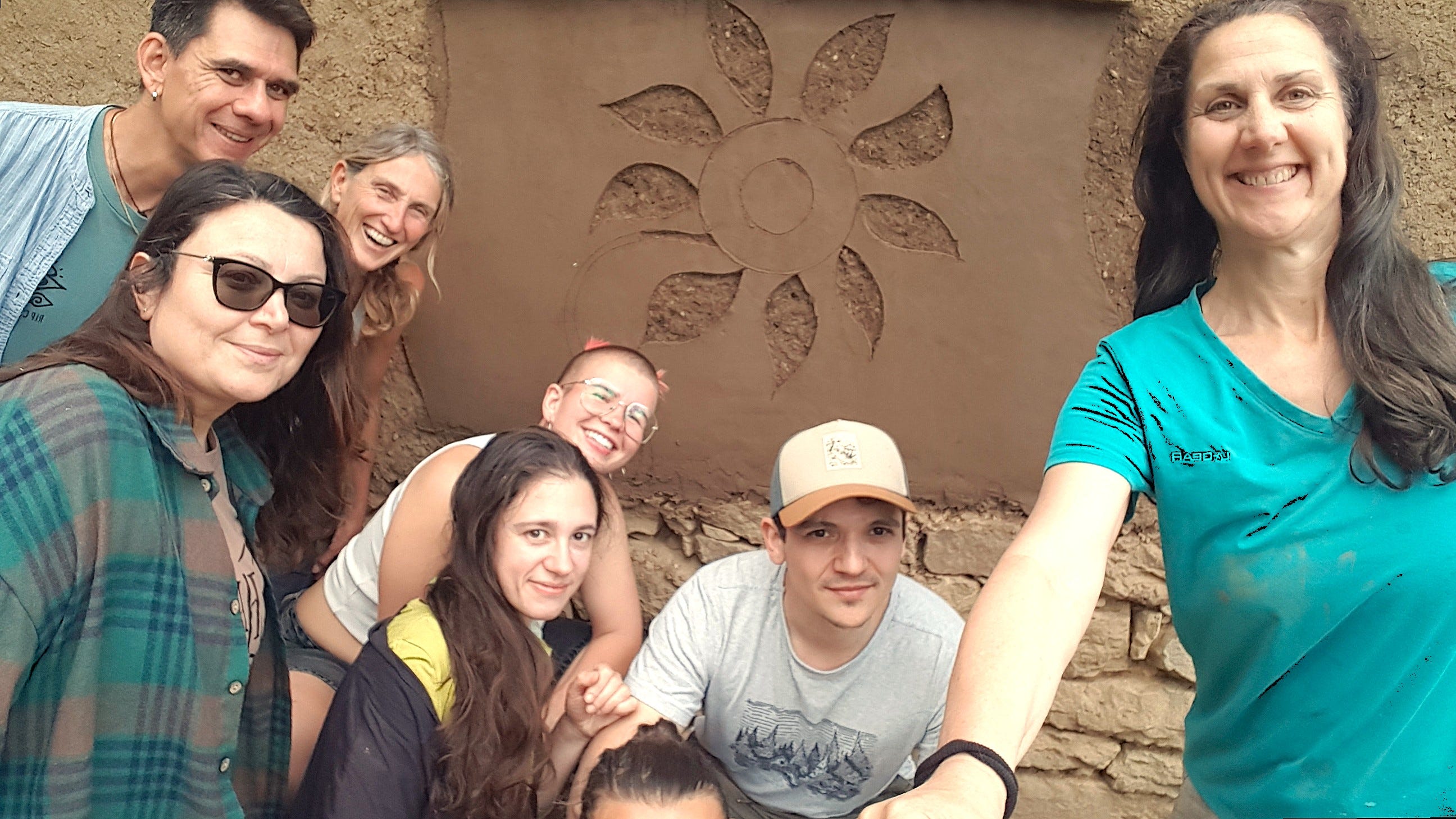
The final day arrived, as it always does. And suddenly it all came together. Our finishing plaster coated the walls like smooth brown silk. The team got into carving. And then the surprises began to materialise. Jen turned out to be a natural dab hand with the trowel. Sage climbed out of the mud pit and turned her hand very competently to compressing the plaster. Nona designed a gorgeous tree carving. And Latcho defied my every expectation by suddenly becoming a master of finishing plaster. He was obsessed.
“It’s such a nice material to work with,” he gushed as he gently worked a palette knife over the surface. Two hours later he was still there.
“I’ve got an old house here in Bulgaria,” he said. “Now I know how I can restore it.”
Finally, everyone left. And as always, I felt rather sad. What a productive two weeks it had been! Cob walls, windows, plastered walls and carvings. As I walked to the courtyard, heavy grey clouds bulged ominously overhead once more like a gang of water thugs. I quickened my step. Then I saw it. It was slumped against the side of the fence like a boxer sagging on the ropes. The fated sieve. The mesh was by now ripped to shreds, and the whole thing resembled a shark-gnawed fishing net. I paused in front of this workshop remnant and saluted. Best teacher we had, and it never said a word.
LAST CHANCE FOR EARLY BIRD TICKETS!
Want to be part of a team and participate in something like this? Join me for a hands-on 3-day Cob Building Workshop at RisingSoul Retreat Centre in the gorgeous Bulgarian countryside.
27–30 August 2026. RisingSoul Retreat Centre, Tryavna, Bulgaria
You’ll learn to:
Test your soil & mix your own cob
Build real walls, foundations & stem walls
Install windows, doors, plumbing & wiring
Sculpt and repair cob like a pro
Meet and have fun with other mudsters.
No experience needed, just curiosity and a willingness to get your hands dirty. You’ll work on a real restoration project on-site, with daily Q&A to help with your own building dreams.
“In a small group I was able to make connections to like-minded people who I will stay in touch with... Everyone worked together and we enjoyed as we learned how to make our natural living dreams come true.” — Sara F., 2026 participant
£260 Early Bird price, just two early bird tickets left.
Book your spot: https://www.tickettailor.com/events/atulyakbingham/2261669
Accommodation booked separately with RisingSoul, camping from 152 EUR/week (breakfast & dinner included).